

Love That Doesn't Rush To Fix


Settle In
Welcome to this week’s edition of The Chaplain Writer Digest.
I’m glad you’re here. Settle in for a few minutes. Pour the coffee. Let the noise of the week grow quiet.
This week, we’re reflecting on Job’s friends sitting with him in silence before they tried to explain his suffering. It may have been their holiest moment.
In a world that pushes us to answer quickly and fix immediately, Scripture invites us into something slower: the ministry of presence. Sometimes love looks like showing up. Sometimes it looks like staying.
What I’m Thinking
“They sat with him on the ground seven days and seven nights, and no one spoke a word to him, for they saw that his suffering was very great.”
— Job 2:13
Some pain does not need words.
That’s hard for us to accept.
We live in a world that likes to fix things. If the sink leaks, we call a plumber. If the phone breaks, we get a new one. If our schedule gets too busy, we try to rearrange it. So when someone we care about is hurting, we naturally want to help. We offer advice, explanations, Bible verses, encouraging words, or stories about others who have faced worse and turned out okay.
We mean well.
Most of the time, we really do.
But sometimes, our urge to fix things comes from our own discomfort, not from what the other person needs. We do not like feeling helpless. We do not like being in a room filled with grief. We do not like the silence after someone says, “I don’t know if I can do this anymore.”
So we talk.
Too quickly.
People often remember Job’s friends for their mistakes, and they made plenty. When they tried to explain Job’s suffering, things got worse. But before they spoke, they did something sacred.
They sat down.
On the ground.
With him.
Seven days. Seven nights. No words.
This is the main idea about God in this passage:
God’s presence often comes before God’s explanation.
We want answers first. God often gives presence first.
That is not a small thing. Sometimes, it is the mercy we need most. When grief has emptied the house and suffering has left us exposed, a lecture cannot rebuild what is broken. A formula cannot calm the storm. But presence says, “You are not abandoned here.”
And isn’t that the way of Jesus?
Jesus did not come to us as just an idea from heaven. He came as a person. He lived among us. He touched those who were sick. He cried at Lazarus’s tomb, even though He knew resurrection was coming. Think about that. Jesus knew how the story would end, but He still allowed space for sadness.
That undoes me a little.
Because I often want to move people quickly to hope without respecting their pain. I want to find the lesson, the main point, the happy ending. But Jesus stays close to those who are hurting and does not rush. His love is shown not just in His words, but in where He chooses to be—with us, beside us, sharing the burden.
Faith does not ask us to act like pain is less than it is. Mental health does not get better just because someone says to “look on the bright side.” A person with anxiety does not need a clever phrase. A grieving widow does not need a detailed explanation. A friend who is depressed does not need someone to try to change how they feel inside.
They need safe presence.
Not the kind of silence that avoids or pulls away, but the kind that remains with someone.
There’s a difference.
I think of early mornings when fog covers a field. Nothing dramatic happens—no thunder, no bright sun yet. Just a quiet gray over the grass. Somehow, in that stillness, the world feels cared for. The ground is damp, the birds wait, and the trees stand without needing a reason.
Presence can be like that.
A quiet fog of mercy.
We might not know what to say. We might feel awkward or worry that we are not helping. But sometimes, helping means sitting with someone whose life has fallen apart and not trying to make things seem better than they are.
People have sat with me like that before. Not perfectly—none of us does this perfectly. But they stayed. They did not try to fix my sadness or cheer me up. They let me be myself, even when I was not okay.
That kind of care is rare.
And healing.
So maybe today, the invitation is simple: sit before you speak, notice before you try to fix, and love before you explain.
As Paul reminds us, “Rejoice with those who rejoice; weep with those who weep.”
Sometimes the holiest thing we can bring is not an answer.
It is ourselves.
Questions to Sit With
Where do I feel the need to fix someone’s pain when God may simply be asking me to be present with them?
Who in my life might need my quiet companionship more than my advice right now?
What makes silence uncomfortable for me when I’m sitting with someone who is hurting?
How might Jesus be inviting me to practice a more patient, self-giving kind of love this week?
A Simple Invitation
If this reflection stirred something in you, I’d love for you to pause and ask one simple question:
Who in my life needs presence more than advice right now?
This week, consider reaching out to that person. Not to fix them. Not to explain their pain. Just to let them know they are not alone.
And if your church is wondering how to become the kind of place where people are met with wise, compassionate, steady care, Shepherding Minds was written to help you take that next step. It offers a practical framework for building a culture of care where people are seen, heard, and gently supported before they fall through the cracks.
Closing Prayer
Lord Jesus, teach me to be present before I try to fix. Slow my words. Soften my heart. Help me sit with others in sorrow the way You sit with me—with patience, mercy, and love. Show me who needs my quiet presence this week. Amen.
Benediction
May you go slowly enough to notice the hurting, gently enough to be trusted, and humbly enough to know you don’t have to fix everything. May the presence of Christ steady your heart, soften your words, and teach you the quiet grace of simply staying near. Amen.
Song To Sit With
Cody Carnes’ “Run to the Father” reflects this issue of The Chaplain Writer Digest because it reminds us that healing begins in God’s presence, not in having all the answers. Like Job’s friends sitting with him in silence, the song invites us to come honestly—with our pain, weariness, and need. We don’t have to fix ourselves first. We come. And as we receive the Father’s steady mercy, we learn to offer that same kind of presence to others.
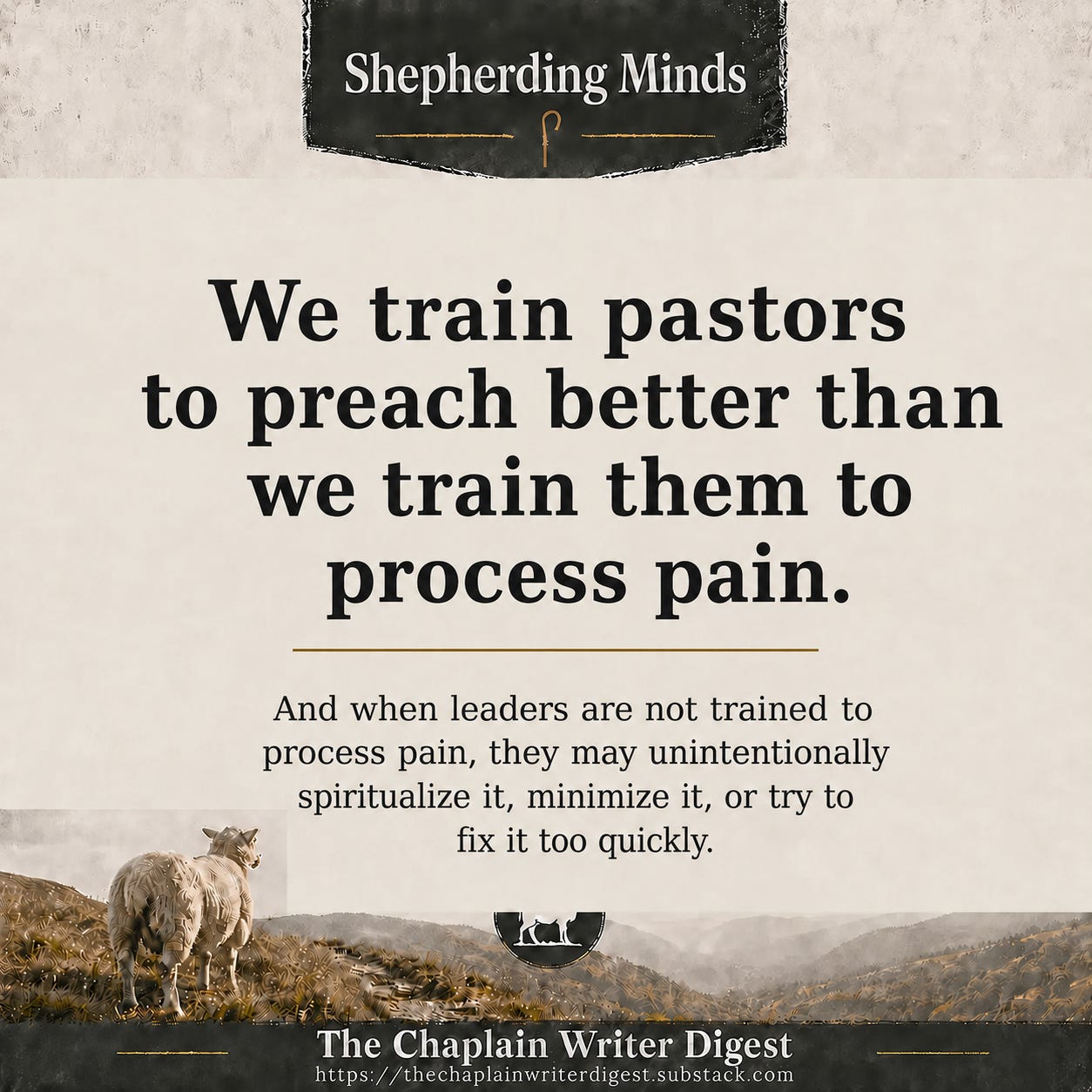
I wrote Shepherding Minds to help church leaders slow down, listen wisely, and walk with people through pain instead of rushing past it. This book was written for pastors, elders, ministry leaders, and caring believers who want to respond to emotional and mental suffering with greater compassion, wisdom, and biblical faithfulness. It does not ask the church to become a counseling center or replace trained professionals. Instead, it offers a practical framework for creating safer, healthier pathways of care so that hidden pain is noticed, burdens are shared, and hurting people are shepherded with patience, clarity, and hope.
That vision has been on my heart for a long time, and over Memorial Day weekend, it took another important step forward. I spent the weekend completing the Final Author Review of Shepherding Minds and have now sent the manuscript back to my editor for one final round of formatting and editing. The tentative target publication date is mid -July 2026.
In the meantime, I’ve created The Shepherding Minds Field Guide, a free practical resource designed to help churches begin wiser, healthier conversations about mental health and shared care. You can download it for free. And if your church would like help exploring or building a Shepherding Minds Care Team, I’d be glad to hear from you by voice message or at jim@thechaplainwriter.com.

Shepherding Minds Field Guide
1.4MB ∙ PDF file
Download the free Field Guide (PDF).
If you would like to discuss your specific ministry context or consider what the next steps might look like, I am also offering complimentary 20-minute introductory calls. You can schedule a call here: 👉 Schedule Your 20 Minute Call
You were never meant to carry this work alone.
Leave A Voice Reflection
One of the quiet gifts of writing The Chaplain Writer Digest is hearing how these reflections find their way into the ordinary places of people’s lives. Sometimes a sentence lingers. Sometimes a thought offers comfort. Sometimes it touches a tender place we did not even know needed attention.
If something in this week’s edition encouraged you, stayed with you, or met you in some meaningful way, I would be grateful to hear from you. Your response does not need to be polished or profound. A few honest words are more than enough.
You can leave a brief 90-second voice message here, or email me at jim@thechaplainwriter.com. And if you have not yet subscribed, I warmly invite you to join us. These reflections are offered each week freely, and I would be grateful to have you along for the journey.
About The Author
James E. Leary, D.Min. (Jim) is a hospice chaplain, former pastor, and author of Embracing Gethsemane: Navigating Life’s Darkest Moments, available on Amazon for readers who want to explore these themes more deeply. He writes weekly at The Chaplain Writer Digest, offering thoughtful spiritual reflections and practical encouragement for everyday faith.
Support the Work
If The Chaplain Writer Digest has encouraged you, strengthened you, or helped you think more deeply about faith, care, and the hidden struggles people carry, I invite you to consider supporting this work through a voluntary pledge. The Digest will remain free and available to everyone. Your support simply helps sustain and expand the work being built through The Chaplain Writer and Shepherding Minds.
📣 Share This With Someone
If today’s reflection encouraged you, consider forwarding it to a friend who might also benefit from the encouragement.
🛑 Disclaimer
This content is for inspiration and reflection and is not a substitute for professional counseling or mental health care. If you or someone you know is struggling, please reach out to a trusted professional.
© 2026 The Chaplain Writer LLC
Thanks for reading The Chaplain Writer Digest! Subscribe for free to receive new posts and support my work.
My daughter recently did not make the cheerleading team. I wanted to fix it or say something to make her feel better. I thought about it, and I simply told her I was sorry and held for a little bit in the quiet. I think that's what she needed the most. A hug.
Thank you for this reminder!