

Encourage The Weary


Settle In
This week, we are reflecting on the quiet ministry of encouragement—the kind that notices weary people, moves toward them with tenderness, and offers strength without rushing to fix what hurts.
Most of us are carrying more than others can see. Some days, even faith feels tired. But Scripture reminds us that God often strengthens His people through His people.
You can also listen to me read this edition of the Digest. Look near the top of this post for the audio/play button, usually located close to the title or just beneath it. Press play, settle in, and let the reflection come to you in a slower, quieter way.
So pour a cup of coffee or tea. Take a few unhurried minutes. Breathe. Read or listen prayerfully. And as you do, ask God to bring one weary person to mind—someone who may need a word of encouragement, a patient presence, or a reminder that they are not alone.
What I’m Thinking
“Therefore encourage one another and build one another up, just as you are doing.”
—1 Thessalonians 5:11
Some days, encouragement feels like a small thing.
A word. A note. A hand on the shoulder. A text sent at the right time. A sentence spoken over coffee when someone’s eyes are tired and their soul is dragging behind them like an old coat.
But Paul doesn’t treat encouragement as small. He places it in the life of the church like a beam in the wall. “Encourage one another,” he says. “Build one another up.” Not once. Not when convenient. Not when someone is obviously falling apart. But as a steady way of life.
And maybe that’s where the problem begins.
We are surrounded by weary people, but we’re often moving too fast to notice them.
We pass one another in hallways, church lobbies, parking lots, grocery aisles, and little glowing screens. We ask, “How are you?” but we’re already halfway to the next thing. And most people know it. So they say, “I’m fine.” They smile. They nod. They carry on.
But many aren’t fine.
They’re tired in places sleep doesn’t touch. Tired from caregiving. Tired from conflict. Tired from trying to hold a family together. Tired from anxiety that hums under the surface like a refrigerator in the next room. Tired from grief. Tired from disappointment. Tired from pretending faith means they shouldn’t feel so tired.
I’ve known that kind of weariness. Maybe you have too. The kind where your body keeps showing up, but your heart has found a quiet corner somewhere and sat down.
And here is the Big Thought about God in this passage: God strengthens His people through His people.
That sounds simple. Almost too simple.
But it is mercy.
God could have made encouragement fall from the sky like morning dew. Sometimes He does. A verse opens. A sunrise burns gold across the trees. A hymn finds the wound. But often, God places His comfort in the mouth, presence, patience, and tenderness of another believer.
He builds us up through one another.
This is not accidental. It is the way of Jesus.
Jesus gave Himself to weary people. He noticed them. He stopped for them. He touched lepers, welcomed children, restored failures, fed hungry crowds, and spoke gently to bruised souls who had been handled roughly by the world. He did not encourage from a safe distance. He came near. That is the self-giving life of Jesus.
And that matters for faith and mental health because weariness isolates us. It convinces us we’re a burden. It tells us to pull back, hide, and keep the trouble contained. But encouragement says, “You don’t have to carry this alone.” It doesn’t fix everything. Good grief, how often we rush to fix what first needs to be heard. Encouragement may not remove the valley, but it can put another set of footsteps beside us in it.
I think of encouragement like placing kindling on a low fire. You don’t scold the embers for being dim. You don’t lecture them about their lack of flame. You come close. You kneel down. You protect what’s still alive. Then you add something small and dry and hopeful.
A word.
A prayer.
A meal.
A visit.
A quiet, “I’m still here.”
And sometimes, almost without notice, warmth returns.
So maybe this week the call is not dramatic. Maybe it’s not to solve every sorrow or answer every question. Maybe it’s simply to look more carefully. To notice the weary. To speak life where silence has grown heavy.
Because encouragement is not sentiment. It is ministry.
And in the hands of God, even a small word can become shelter.
“Strengthen the weak hands, and make firm the feeble knees.”
—Isaiah 35:3
Call to Action
This week, look for one weary person.
Not ten. Not everyone. Just one.
Someone whose eyes look tired. Someone who has grown quiet. Someone who keeps saying, “I’m fine,” but you suspect there is more beneath the surface. Send the text. Make the call. Write the note. Invite them for coffee. Pray with them. Sit with them. Don’t rush to fix what first needs to be heard.
Ask God to make you attentive to the embers still glowing in someone else’s life.
And when you see them, come close with gentleness.
A small word of encouragement may feel ordinary to you, but in the hands of God it may become shelter, strength, and grace for someone who is trying hard not to give up.
Questions to Sit With
Who around me may be weary right now, even if they keep saying, “I’m fine”?
Where have I needed encouragement lately, and have I allowed anyone to come near enough to offer it?
What would it look like this week to encourage someone without trying to fix them?
How might God use one small word, prayer, note, visit, or act of kindness to strengthen someone whose fire is burning low?
Closing Prayer
Father, open my eyes to the weary people around me. Slow me down enough to notice what others may be carrying beneath the surface. Give me the tenderness of Jesus, who came near to the wounded, the tired, and the overlooked. Teach me to encourage without rushing to fix, to listen without judgment, and to speak words that strengthen rather than burden. And when my own fire burns low, remind me that You often send grace through the quiet presence of Your people. Amen.
Benediction
May the God who sees the weary give you eyes to notice them.
May the tenderness of Christ shape your words.
May you encourage without rushing to fix.
And when your own fire burns low, may you remember:
God still strengthens His people through His people.
Go in peace.
Song To Sit With
Rhett Walker’s version of “Goodness of God” encourages the weary by reminding tired hearts that God’s faithfulness has not disappeared, even when strength is low, and life feels heavy. The song does not encourage by offering quick answers or shallow optimism. It encourages by helping the weary look back and remember: God has been present, merciful, and steady through every season. That kind of remembrance can become kindling for a dim soul. It says, “You are not abandoned. You are still being pursued by the goodness of God.” When you feel worn down, that reminder can help you take one more step in faith.
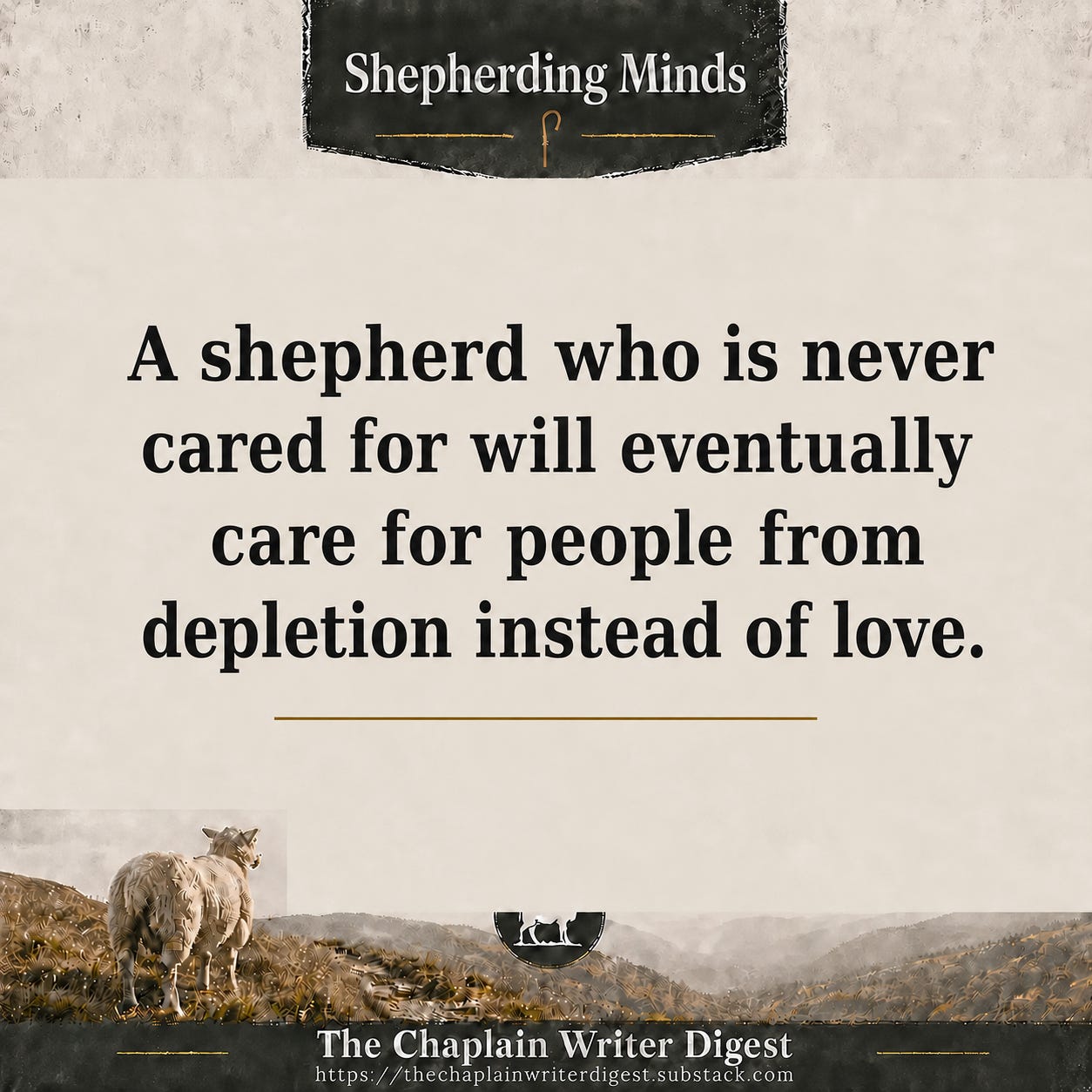
One of the reasons I wrote Shepherding Minds is because I have seen how easily shepherds can pour themselves out while quietly neglecting their own souls. A shepherd who is never cared for will eventually care for people from depletion instead of love. That does not usually happen all at once. It happens slowly, through accumulated burdens, unresolved pain, compassion fatigue, and the constant pressure to be strong for everyone else. Shepherding Minds was written to help churches recover a healthier way of caring—not only for those who are hurting, but also for the pastors, leaders, and caregivers who walk with them.
As the publication date approaches, I’ve also created The Shepherding Minds Field Guide, a free, practical resource designed to help churches begin wiser, healthier conversations about mental health and shared care. You can download it for free. And if your church would like help exploring or building a Shepherding Minds Care Team, I’d be glad to hear from you by voice message or at jim@thechaplainwriter.com.

Shepherding Minds Field Guide
1.4MB ∙ PDF file
Download the free Field Guide (PDF).
If you would like to discuss your specific ministry context or consider what the next steps might look like, I am also offering complimentary 20-minute introductory calls. You can schedule a call here: 👉 Schedule Your 20 Minute Call
You were never meant to carry this work alone.
Leave A Voice Reflection
One of the unexpected joys of writing The Chaplain Writer Digest is hearing how these reflections meet people in the middle of real life. A sentence finds its way into a morning commute. A thought stays with someone through a difficult conversation. A quiet line offers comfort in a place that needed more care than words could fully explain.
If something in this week’s edition encouraged you, stayed with you, challenged you, or met you in a tender place, I would be grateful to hear from you. It does not need to be polished. It does not need to be profound. A few honest words are more than enough.
You can leave a brief 90-second voice message here, or email me at jim@thechaplainwriter.com. And if you have not yet subscribed, I would be glad to welcome you into this growing community. These weekly reflections are offered freely, with the hope that they bring encouragement, perspective, and steady gospel-shaped care for the journey.
About The Author
James E. Leary, D.Min. (Jim) is a hospice chaplain, former pastor, and author of Embracing Gethsemane: Navigating Life’s Darkest Moments, available on Amazon for readers who want to explore these themes more deeply. He writes weekly at The Chaplain Writer Digest, offering thoughtful spiritual reflections and practical encouragement for everyday faith.
Support the Work
If The Chaplain Writer Digest has encouraged you, strengthened your faith, or helped you better understand the hidden burdens people carry, I invite you to consider supporting this work through a voluntary pledge. Your support helps us continue offering these weekly reflections freely while also expanding the work of Shepherding Minds—a growing effort to equip churches to care compassionately and faithfully for those who are hurting. The Digest will remain free and available to everyone. Your pledge simply helps sustain the writing, resources, training, and care-centered tools being developed through The Chaplain Writer and Shepherding Minds.
📣 Share This With Someone
If today’s reflection encouraged you, consider forwarding it to a friend who might also benefit from the encouragement.
🛑 Disclaimer
This content is for inspiration and reflection and is not a substitute for professional counseling or mental health care. If you or someone you know is struggling, please reach out to a trusted professional.
© 2026 The Chaplain Writer LLC
Thanks for reading The Chaplain Writer Digest! Subscribe for free to receive new posts and support my work